Short answer
Protect the card before it reaches the soil
Store finished seed-paper cards in a clean, dry place away from heat and direct sunlight. Pack them so the printed cards stay flat and do not rub or get wet in transit. Before an international shipment, identify the embedded seed and check the rules for the specific destination. None of these steps establishes a shelf life or guarantees germination.
Why handling matters after printing
A plantable card is both printed paper and a carrier for seeds. Moisture, temperature, and the time spent in storage can matter to seeds; rough handling can also crease or scuff a finished card. Colorado State University Extension identifies seed moisture and storage temperature as important for loose vegetable and flower seeds. Its numerical storage recommendations are not a validated shelf-life specification for finished Papyrn cards. Treat cool, dry storage as a sensible precaution and ask for testing if a campaign requires a quantified claim.
Before a campaign: store by order, not by an assumed expiry date
Keep the cards dry and flat in their approved packaging, out of direct sun and away from heaters or other hot areas. Avoid a damp storeroom or a long wait in a hot vehicle. Do not seal a visibly damp card or one with condensation inside an enclosure. A sleeve or bag is only useful if the card is dry when packed and the final pack has been checked.
For a delayed event or multi-wave campaign, record the production batch, confirmed seed identity, packing date, and intended dispatch window. Use those records to discuss a reasonable release plan with the supplier; do not print an invented "best before" date. If the cards will sit for an unusually long period, ask whether a current finished-card test is appropriate. Our viability and germination guide explains what such evidence can and cannot show.
Pack for the actual journey
First check the inkjet print is ready for handling. Then sample the proposed pack with the real card size and quantity: keep stacks aligned, prevent edge damage and bending with suitable support, and limit rubbing against other items. If cards will ride inside a product parcel, test the fully packed parcel; a heavy product or loose filler may shift onto the cards. If they will be mailed alone, check the mailer and backing with a physical shipment sample. Do not assume a photograph or a flat empty envelope proves the cards will arrive flat and dry.
The packaging choice should match the route and buyer's presentation needs. An inner wrap can separate cards from other products, but no ordinary sleeve should be described as a tested moisture barrier without evidence. Keep the confirmed seed name and batch information available for the order even if it is not printed on the card.
Shipping to the United States or Europe: verify before promising
Papyrn can discuss sending seed-paper cards to U.S. and European buyers, but this is not a blanket statement that any seed-paper card is admissible everywhere. The plant species, origin, destination country, and shipment purpose may change what is required. The USDA APHIS import guide directs importers to check requirements by commodity and origin; the European Commission plant-health guide describes certification requirements for covered plant products entering the EU. Confirm the exact seed and applicable documents with the responsible authority or importer before dispatch.
Do not translate a supplier's common-name label into a species name just to complete shipping paperwork. Our seed-selection guide explains why botanical identity has to be confirmed for the actual order.
What to agree before the cards leave the factory
- Card and seed: Confirm size, quantity, artwork, embedded seed identity, and which production batch is being shipped.
- Timing: Share the event or campaign date, planned dispatch date, and any expected holding period.
- Packing: Approve a physical card and its proposed mailer, support, or inner wrap for the intended route.
- Destination: Identify every receiving country and confirm current import, labeling, and document requirements before a delivery promise.
- Recipient copy: Give clear planting instructions only for the confirmed seed. Avoid fixed sprout dates and guaranteed seedling counts.
After delivery: keep the instructions honest
The recipient should know that the card is plantable, what seed it contains once verified, and where to find the approved planting directions. Ask them to store it dry until use and follow the instructions for that seed. An attractive pack is not evidence that the seed has survived the journey, and careful storage does not guarantee a particular germination result. Keep any performance percentage off the card unless you have relevant, dated evidence for the finished batch.
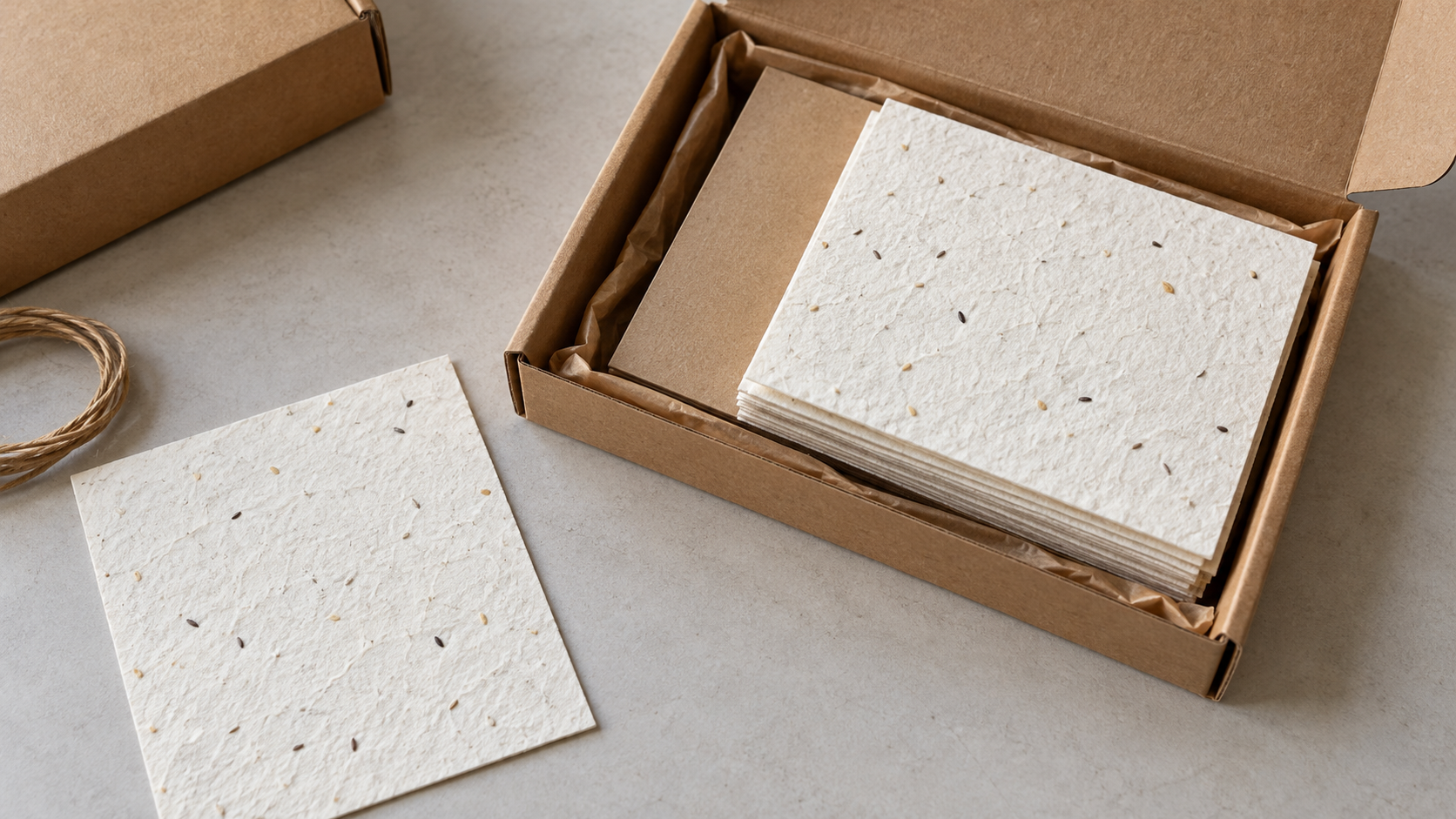
Published October 28, 2026. The storage advice above is practical handling guidance, not a measured shelf life for Papyrn's finished cards. Cross-border requirements must be checked for the confirmed seed and destination at the time of shipment. The hero image is illustrative.
FAQ
Storing and shipping seed-paper cards
Should finished plantable cards be kept cool and dry?
Yes, as a practical handling precaution: keep finished cards dry, away from direct sun and heat, and protected from bending. This is not a tested storage-life specification for a particular finished card or seed lot.
Can I seal a damp seed-paper card in a sleeve?
No. Do not pack a card that is damp or has condensation. Let the supplier confirm the paper is ready for packing, then approve the actual packing method with a physical sample.
Can Papyrn ship seed-paper cards to the United States or Europe?
We can discuss shipments to those destinations, but acceptance is not automatic. Confirm the embedded seed's identity, country of origin, exact destination, and current import and document requirements before promising delivery.
Does careful packing guarantee germination?
No. Packing helps protect the finished card during handling, but it does not certify seed viability or promise that recipients will get seedlings. Growing outcomes depend on the seed, the card, storage history, and planting conditions.