Short answer
Which of the three approaches should you start with?
Pack the actual products in their intended arrangement first. If they remain in place and the box closes cleanly, extra material may be unnecessary. If each item needs a defined position or separation, discuss a fitted insert. If the main task is filling visible gaps or improving presentation, test paper filler. None of these choices should be made from a photo or the number of items alone.
Compare the job before choosing the material
The complete set packs closely and stays in its intended position. Confirm the closed-box fit, side-tuck clearance, and movement with the real products.
Consider a shaped inner support when positions must be controlled or items kept apart. Confirm the actual insert design, material, assembly, cost, and effect on the box size with a sample.
Use tested amounts to manage visible empty space and presentation. Check dust, color transfer, direct product contact, and whether a separate protective solution is needed.
Example: the painting set needed no extra divider
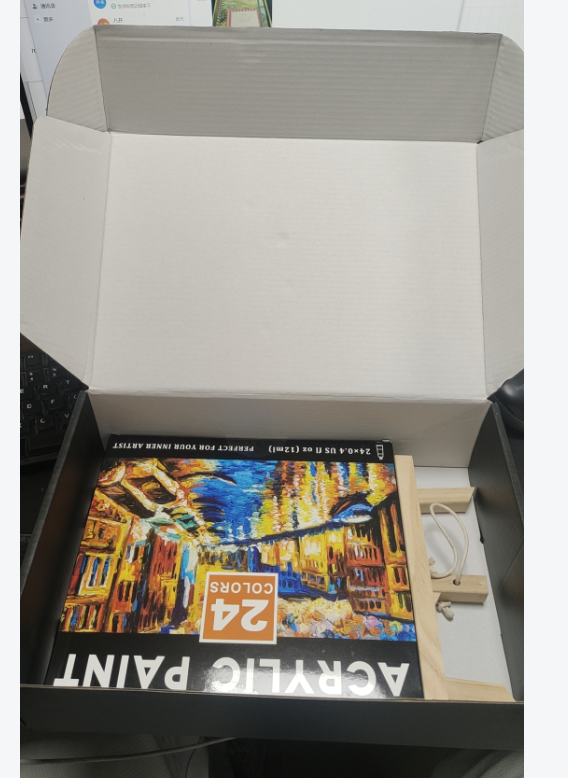
In Papyrn's multi-item painting-set case, shown above, the contents filled the chosen mailer-box layout closely enough that an additional divider was not needed. The box was planned around the full arrangement, not around one item in isolation. The longest component measured 28.2 cm against a proposed 29.2 cm inside length; the arranged set measured 20.2 cm across against a 20.7 cm inside width. Those differences describe this specific project, not a standard packing allowance.
Even a closely filled box still needs a closing check. The lid's side sections enter the box beside the products and occupy some inside space. See our product-fit guide for both this example and a spiral-notebook case.
When to discuss a fitted insert
An insert is worth considering when the products do not stay where the design requires, or when separate components should not rub against each other. Start with the product positions and the problem to solve. An insert may also change assembly work and the inside space available to the products, so it should be checked in the complete box rather than priced as an isolated piece.
The word insert does not specify a material or a tested protection level. Ask the supplier to propose the actual construction for the contents, quantities, and handling route. Approve its fit and assembly in a physical sample before bulk production.
When paper filler is enough, and when it is not
Paper filler can soften the look of empty space, support a light presentation layer, and coordinate colors across a gift set. It is often simpler than a shaped insert when exact positioning is not needed. But loose paper does not automatically keep heavy, fragile, sharp, or scratch-sensitive items safely separated during delivery.
Test the filler with the actual box and products. Confirm the cut, color, quantity, direct-contact suitability, and packing method. If the goal is impact protection, choose and test a suitable protective system rather than relying on a decorative appearance. Our paper-filler guide explains the quantity test in more detail.
Approve the finished pack, not one loose component
- Arrange the entire set exactly as it will be packed.
- Check whether the contents already remain in position without added material.
- If not, decide whether the problem is item placement, empty space, presentation, or a protection requirement.
- Sample the proposed insert or filler inside the finished-size box.
- Close the lid and side tucks; reopen and check movement, contact, pressure, and ease of unpacking.
Send the supplier product photos, dimensions, weights, the arrangement, order quantity, and destination. A clear photo of the packed set helps distinguish an unnecessary add-on from a useful inner solution.
Published October 24, 2026. The painting-set dimensions are one project example, not a universal clearance or protection guarantee. Insert specifications, filler quantities, prices, and suitability depend on the confirmed products, layout, sample, and delivery conditions.
FAQ
Mailer-box inserts and filler
Does every multi-item mailer box need an insert?
No. If the complete set is arranged securely and a physical closing and handling check confirms that the items stay in place, extra packing material may not be needed. Do not decide from the item count alone.
When should I consider a fitted insert?
Consider an insert when the layout needs defined positions or when components should be kept apart. The insert material, construction, cost, and suitability must be reviewed for the actual products and box.
When does paper filler make sense?
Paper filler can fill visible gaps and support the presentation of lightweight products. Its cut, quantity, contact suitability, and packing method should be tested with the real set. Decorative filler is not automatically a verified shipping-protection system.
Can I skip both an insert and filler?
Yes, when the product arrangement itself works. Test the complete set in a physical box, close the lid and side tucks, then check for movement and pressure. Change the plan if the contents or box change.