Short answer
Choose the smallest set of box sizes that packs your real orders well
A shared mailer size is worth considering when the products and common product combinations fit securely with a repeatable packing method. Use more than one size when the shared box leaves smaller orders loose, needs excessive filler, slows packing or increases delivered cost. There is no universal percentage of empty space or fixed number of SKUs that decides this. Test the actual product configurations, including inserts and closure flaps, then compare the total cost of each option.
1. List the orders you actually ship
Start with the order combinations, not just the catalog. A single notebook, a notebook plus a card, and a multi-item gift set may require different space even when they share a main product. Record the maximum packed dimensions and weight of each typical configuration, including sleeves, accessories and protective wraps. Note how often each configuration occurs; an unusual largest item should not silently determine the size of every ordinary shipment.
If a product has a spiral binding or protruding part, measure the real maximum point. For a mailer, the side-tuck flaps also occupy room when the lid closes. Our product-fit guide explains both checks with measured project examples, but those examples are not sizing formulas for your products.
2. Trial one shared box and a two-size option
Make a physical sample or use actual boxes close to the proposed inside dimensions. Pack each representative order exactly as staff would pack it for shipment. Close the box fully, then check:
- Can the product be inserted and removed without scraping, bending or forcing the closure?
- Do the lid and side flaps close reliably after any tissue, card or insert is added?
- Does the product stay in position when the closed pack is handled normally?
- How much tissue, paper filler or fitted support is needed for each order type?
- Can the same packing method be repeated consistently during a busy shift?
A tight box may eliminate loose filler for a stable set, while a more variable order may need an insert or paper filler. Do not assume a larger box becomes protective simply because extra filler can be added later. Verify the closed, packed sample.
3. Compare the complete options, not only the box unit price
One box specification and artwork to order and track, if all designs are truly the same
Separate quantities, minimums, proofs and storage positions for each size
Measure any extra filler or tissue needed in smaller orders
Measure the actual use for each closer-fitting box
Fewer box choices but possibly more adjustment inside
More box choices but potentially less space to manage
Price the actual outer dimensions and weight of the packed order
Price each size using the carrier and destination that will really be used
Some parcel services compare actual and dimensional weight. UPS explains its dimensional-weight method; the divisor, rounding and applicable service vary, so ask your carrier or forwarder for the quote that applies to your route. A smaller box does not automatically create a saving if its separate production MOQ and packing process cost more.
4. Make the decision from your order mix
For each option, calculate the cost per common order configuration: box, measured filler or tissue, packing effort and quoted delivery. Then weight the comparison by how often each configuration occurs. Keep sample and setup charges, unused inventory and storage in view. The packaging cost calculator can help compare entered material charges, while the stock planner shows which component limits complete sets. Neither tool can determine physical fit; that must be tested.
If one size works for most orders but not a larger gift set, a practical decision may be one main size plus a second size for that set. If two products are almost the same packed footprint, the extra size may not justify another order line. These are possibilities, not a recommendation for an untested SKU mix.
What to send the box supplier
We ship these common product combinations: [list each combination and approximate order share]. The maximum packed size and weight of each are [measurements]. Please compare one shared mailer size with a two-size option. For each option, state the proposed inside and outside dimensions, structure and board, quantity and minimum per size/design, sample cost, box price, packing assumptions and carton data for freight. We will test the actual packed products and closed flaps before approving bulk production.
Keep unknown quantities or freight charges marked as unknown until measured or quoted. If designs differ across sizes, list the artwork split explicitly; see our mixed-design MOQ guide.
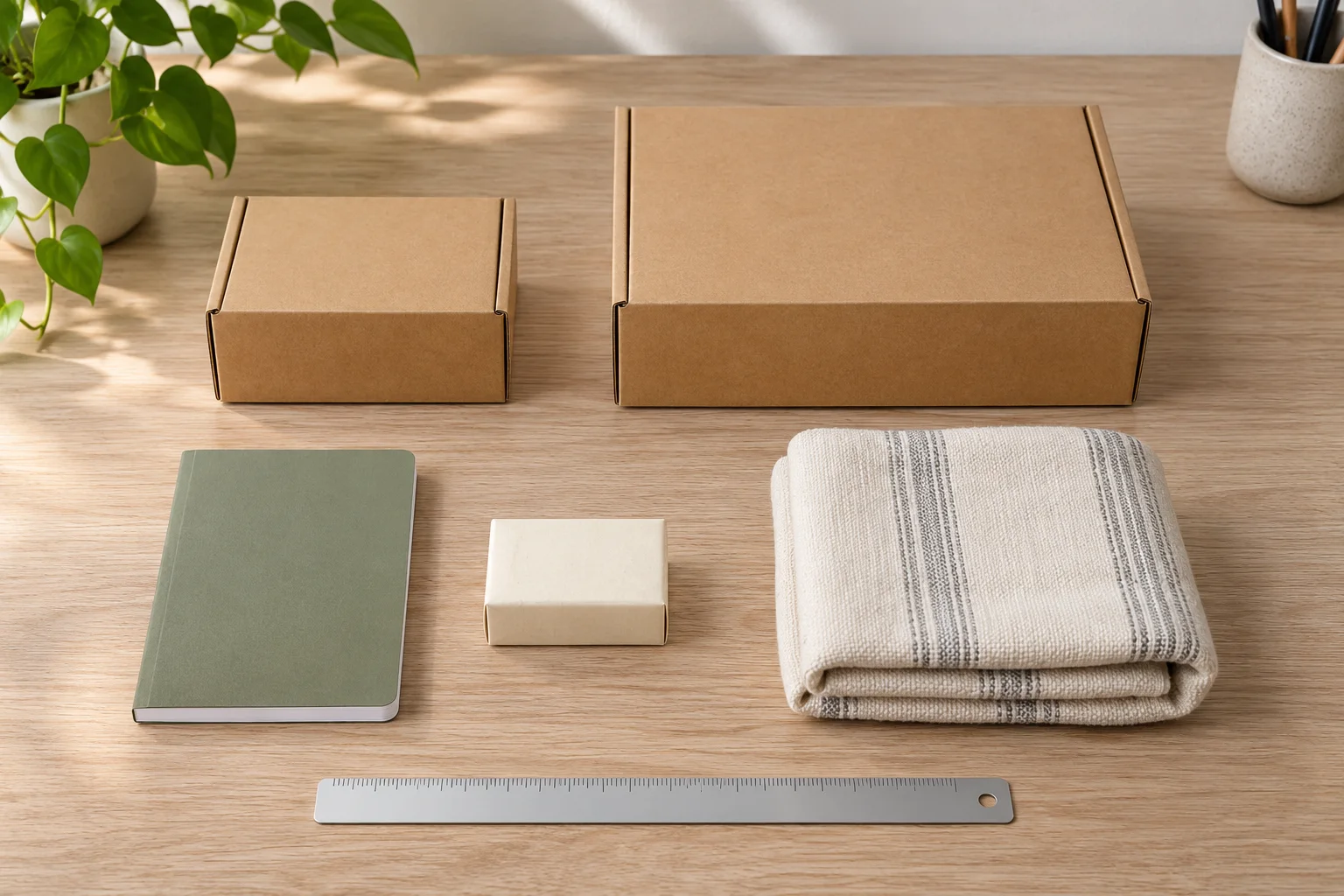
Published November 15, 2026. This is a decision method, not a reported customer case. The image is illustrative. No fit, freight saving or universal box dimension is promised; confirm all options with physical samples and current quotes.