Short answer
Use the simpler card when the message must do the work
Choose a conventional thank-you card for dense instructions, small type, sharp color, or a QR-led customer journey. Choose seed paper when a short, readable message and an optional planting experience genuinely suit the audience. Both can begin at 100 pieces, but their prices are calculated on different bases; a seed-paper material rate is not a finished-card price.
The differences that affect an order
More room for dense copy, fine detail, and a clear QR destination.
Best for a short message plus concise planting directions for a confirmed seed.
Smoother stock is the more predictable starting point for fine text and precise artwork.
Fibrous paper varies in texture; Papyrn uses inkjet printing, so proof type, color, and QR codes on the actual paper.
The customer may keep the card for reference.
The customer may plant it; important order, care, or legal information needs another durable home.
Ask for a finished-card quote that specifies the stock, print, finish, quantity and delivery terms.
Ask for a separate finished-card quote with the seed, paper weight, inkjet proof, cutting and delivery terms confirmed.
Compare finished cards, not material rates
A seed-paper material rate does not cover cutting yield, printing, proofing, packing or delivery. It cannot be compared directly with a finished conventional-card price. Our seed-paper cost guide contains the material-area example and its limits.
Request two finished-card quotes for the same size, quantity, artwork and destination. Confirm what is included in each print proof and delivery basis before deciding on cost.
Three useful ways to decide
Repeat ecommerce orders
If the card must carry product care, warranty information, or a QR code that reliably scans, start with a conventional card. It can still have a warm message; the material need not be unusual to be useful. See our product insert card guide for message and QR checks.
Gift or campaign insert
If the card's main job is a brief greeting and the recipient is likely to appreciate planting it, seed paper may add a memorable next step. Keep the card easy to read, confirm the seed identity, and avoid promising that every card will sprout. Our seed-paper buying guide covers use cases and selection.
Mixed audiences or destinations
A regular card may be simpler when a campaign spans countries or when not every recipient can plant the card. For seed paper, check the embedded seed and destination-specific shipment requirements before making delivery claims. Storage and shipping are separate planning steps, not a reason to assume that every route is permitted.
Sample both in the real packed order
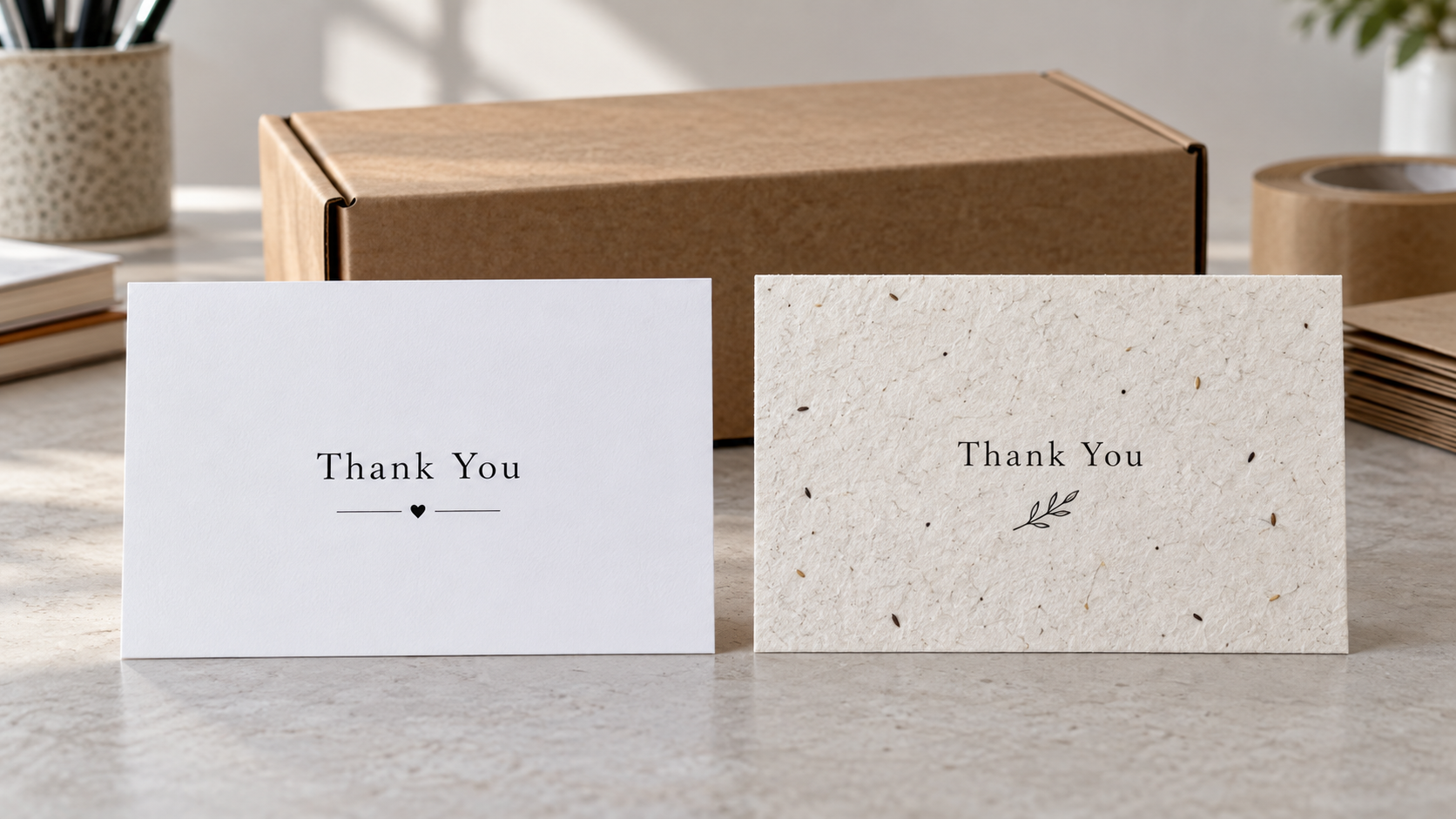
Set the two cards side by side at the same finished size. Check the printed message, color, QR code if any, and how each card sits inside the complete box. A smooth card may make a detailed design easier; a seed-paper card may need larger type and more breathing room. Do not choose from screen mockups alone. The seed-paper inkjet guide covers physical proofing.
If the recipient will plant the seed-paper card, the thank-you should still make sense when they do not. Do not print a fixed sprouting deadline or a percentage without relevant evidence for the finished batch. See our viability guide for that distinction.
Send one brief to compare like with like
- Finished size, flat or folded format, quantity per design, and delivery country.
- Exact artwork, including the smallest text and any QR code.
- Whether the card must retain instructions after delivery or is intended to be planted.
- Preferred standard-card stock and finish, and the seed-paper option to verify.
- Sample requirements, packing method, and target delivery date.
Papyrn seed-paper cards start at 100 pieces; suitable conventional flat cards can also start at 100 per design. Final price and seed availability are confirmed for the order rather than inferred from a material-area reference.
Published October 29, 2026; updated November 1, 2026 to keep the material-area calculation in the dedicated cost guide. The comparison here concerns finished-card suitability and quote scope. The image is illustrative.
FAQ
Choosing the card
Can I compare a seed-paper material rate with a standard-card quote?
No. A material-area rate does not include converting and delivering a finished seed-paper card. Request finished-card quotes for the same size, quantity, artwork, and destination. The separate seed-paper cost guide explains the material calculation.
What is the minimum order for either card?
Papyrn seed-paper cards start at 100 pieces. Suitable standard flat thank-you cards can also start at 100 cards per design. Confirm the final specifications and quantity per design before ordering.
Which card is better for tiny text or a QR code?
A conventional smooth card is usually the safer starting point for dense text and precise detail. Seed paper is inkjet printed; test any small text or QR code on the actual stock before approving it.
Will every seed-paper card grow?
No. A plantable card offers the option to plant it, not a guaranteed seedling. Seed identity, production, storage, and the recipient's conditions all matter.